American Doughboy Bringing Home Victory
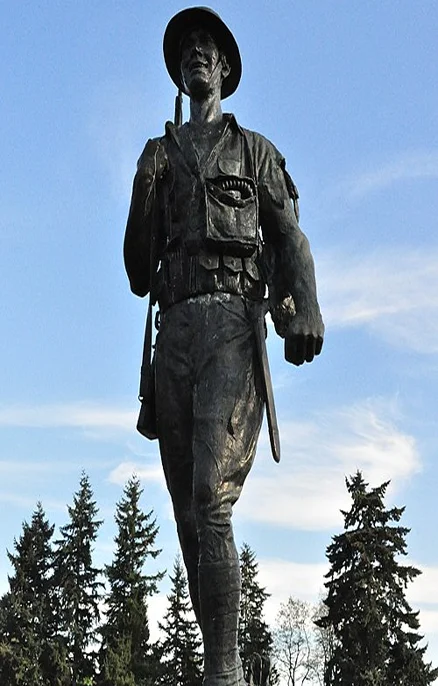
American Doughboy Bringing Home Victory, also known as Armistice and Spirit of the American Doughboy, is an outdoor 1932 bronze sculpture that stands 12 feet tall.
The sculpture is the work of Alonzo Victor Lewis (1886-1946). Lewis was born in Logan, Utah, and initially studied painting under the western painter Edgar S. Paxton in Butte, Montana. During the early 1900s, he studied painting and sculpture at the Chicago Art Academy. Lewis, following his studies in Chicago, spent three years traveling between New York City, Cuba, and Mexico before returning to the Pacific Northwest and eventually settling in Seattle, Washington, in 1919.
The U.S. Army, in 1917, organized the 91st Infantry Division composed of men from Alaska, Oregon, Washington, and other western states. Veterans of the Division approached Lewis to create a statue of a soldier returning from the battlefield, which he completed a clay model in December 1922. Lewis described his work, “When I started on my American Doughboy, I wanted to portray America’s participation in the struggle, America’s glorious victory and at the same time, do it with a smile.” (American Doughboy Bringing Home the Bacon, 90).
Veterans Memorial Cemetery
Fred Poyner IV describes the statue, “a smiling soldier, his left eye closed in a wink, wearing an infantryman’s uniform—boots, leggings, belt and helmet—and with a Springfield M-1 rifle with bayonet affixed slung over the right shoulder. Also slung across his shoulder were two German helmets, souvenirs from the European battlefields. The soldier’s left hand is closed in a fist and frozen in the action of the arm swinging forward in tandem with the left foot, captured in mid-stride.
The completed bronze statue was dedicated on November 11, 1932, outside Seattle Center's Veterans Hall. The statue, in 1962, was moved behind the Opera House and again was relocated, in 1998, to the Veterans Memorial Cemetery at Evergreen Washelli Memorial Park. The sculpture has withstood controversy related to its facial expression and the war souvenirs displayed. Elements of the sculpture—bayonet on the rifle and the German helmets—have been detached.